
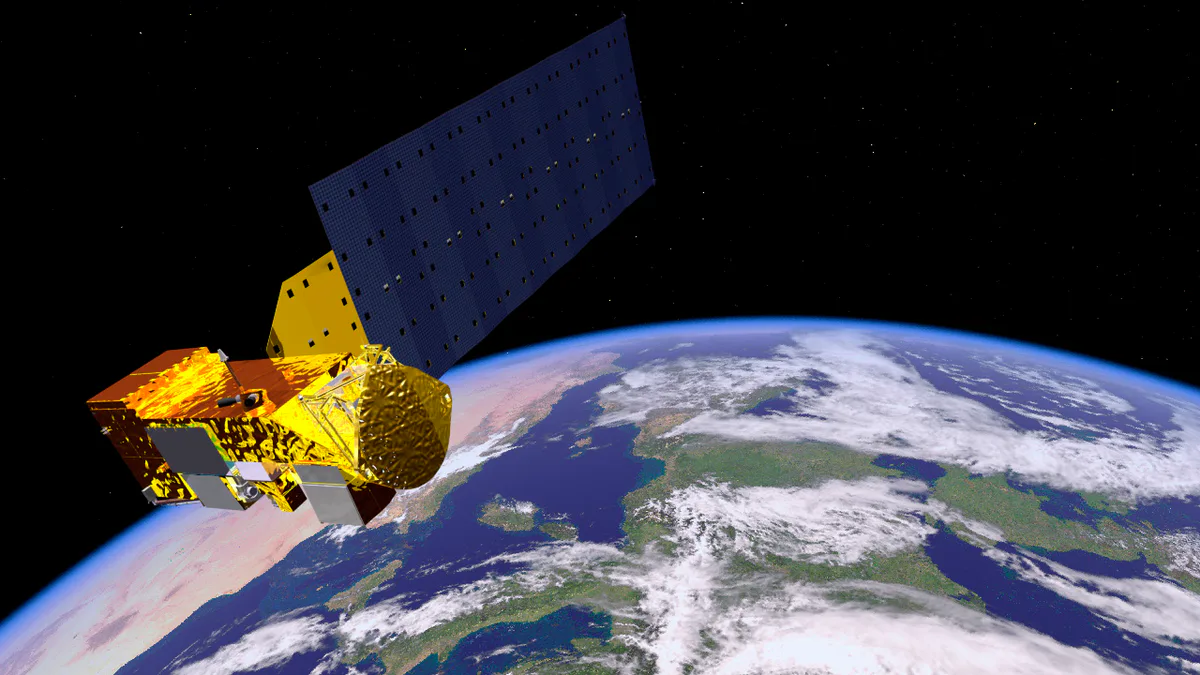
A satellite in orbit is falling. It does not escape gravity, and gravity at the altitude of the International Space Station is around ninety per cent of its strength at the surface. What distinguishes an orbiting object is not that it is beyond gravity's reach but that it is moving sideways fast enough to keep missing the ground.
Falling around the Earth
The standard illustration is Newton's cannonball. Fire a cannon horizontally and the ball travels some distance before gravity brings it down. Fire it harder and it lands further away. Because the Earth is curved, the surface falls away beneath the ball as it travels, and at sufficient speed the ball's downward curve matches the curve of the planet. It falls continuously and never arrives.
That is an orbit. The required speed is about 7.8 kilometres per second near the Earth, roughly 28,000 kilometres per hour. Weightlessness aboard a spacecraft follows from the same fact: the station, its crew and everything in it are falling together at the same rate, so nothing presses against anything else.
Why altitude determines speed
Higher orbits are slower. Gravity weakens with distance, so less speed is needed to balance it, and the circumference to be travelled is greater. Both effects lengthen the orbital period.
At roughly 35,786 kilometres above the equator, the period reaches exactly one day. A satellite there keeps pace with the rotating Earth and appears to hang motionless above a fixed point on the ground. This is geostationary orbit, and it is why a satellite dish is bolted in place and never has to track anything.
The trade-off is distance. A signal to a geostationary satellite and back travels more than 70,000 kilometres, which imposes a delay of around a quarter of a second — unnoticeable for broadcasting, awkward for conversation, and unacceptable for applications that depend on fast response.
The main orbital regimes
- Low Earth orbit, from roughly 160 to 2,000 kilometres. Short delay and cheap to reach, but each satellite is above any given point only briefly, so continuous coverage requires many of them. Used for the space station, Earth observation and the newer broadband constellations.
- Medium Earth orbit, from about 2,000 to 35,000 kilometres. Home to navigation systems including GPS and Galileo, where a moderate number of satellites gives global coverage.
- Geostationary orbit, at 35,786 kilometres above the equator. Fixed apparent position, used for broadcasting, weather observation and regional communications.
- Polar and sun-synchronous orbits, which pass near the poles while the Earth turns beneath, allowing a satellite to survey the entire surface and to cross each location at a consistent local time.
Why orbits decay
The atmosphere does not end at a line. It thins gradually, and even at several hundred kilometres there is enough gas to exert drag. That drag removes energy, the orbit lowers, and lower orbits encounter thicker air, which increases the drag. The process accelerates until the satellite re-enters and burns up.
Satellites in low orbit therefore carry propellant and periodically boost themselves back up. The station is raised regularly for this reason. When the propellant runs out, the end is a matter of time — which is also the mechanism by which low orbits eventually clear themselves of debris, though slowly, and more slowly the higher the orbit.


Discussion